
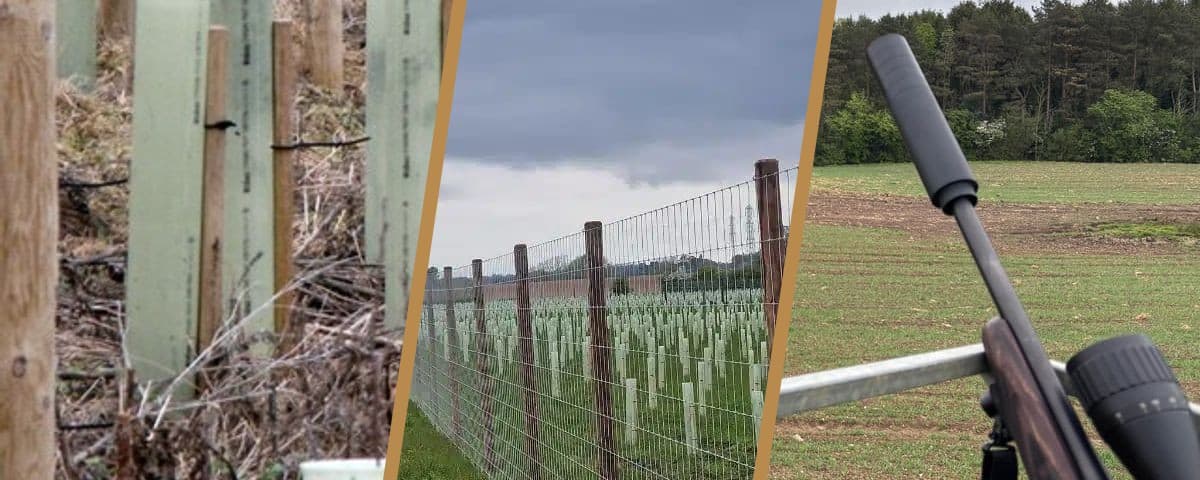
Fencing, Guards, or Culling: Which Actually Solves Your Deer Problem
By Chris Donaldson · 17 September 2026
Ask five landowners how they dealt with deer damage and you'll get three different answers, sometimes from the same person in different years. Fencing, guards, and culling all work. None of them work everywhere, and picking the wrong one costs money without fixing the actual problem.
What each one is actually good at
Guards protect individual trees and hedgerow whips cheaply, one at a time. Fencing protects a defined block of land, a whole planting scheme or an orchard, in one go. Culling deals with ongoing pressure across open land that doesn't have a boundary to protect in the first place. They're not competing options so much as tools for different shapes of problem.
The question that actually decides it
It comes down to what you're protecting and how much of it. A handful of trees or a length of new hedge: guards. A defined area you can draw a fence line around: fencing. Open farmland, established woodland, or land where the damage keeps shifting: that's culling territory, since there's nothing to fence around and guarding every tree individually stops making financial sense past a certain point. Land close to houses and busy footpaths, common around Wetherby and the Wharfe valley in West Yorkshire, can tip the balance toward fencing or guards, since culling only happens where it can be done safely.
Cost and upkeep don't stop at installation
Guards are cheap per tree but add up fast at volume, and need checking as stems thicken. Fencing costs more upfront and keeps costing you: gates, weak points, storm damage, forever. Culling has no equipment to maintain at all, just a survey and the odd repeat visit, which is part of why it tends to win out on land too large or too open for the other two.
The step that decides all three, not just one
None of this can be answered without knowing what's actually on the land: which species, how many, what they're doing. That's the same deer survey whichever way you're leaning, and it's often what changes the answer entirely, guards to fencing, fencing to culling, or a genuine mix of more than one. Where the answer turns out to be numbers, our free deer culling and control is carried out to a plan you agree, and the roe deer case study shows how that played out on a new woodland.
Worth knowing before you spend anything
If fencing or guards turn out to be the right call, grants like EWCO can cover a large share of the cost. Culling doesn't need a grant to be free: it already is, through us, regardless of what a grant round is offering this year.
Wondering about your own land?
Give us a call and we'll talk it through.
Or call Chris on 07397 942663. He'll call you back the same day.
More from the blog