Tree Guards: What Height Actually Stops Deer (and Why So Many Fail Anyway)
By Donaldson Deer Service · 9 September 2026
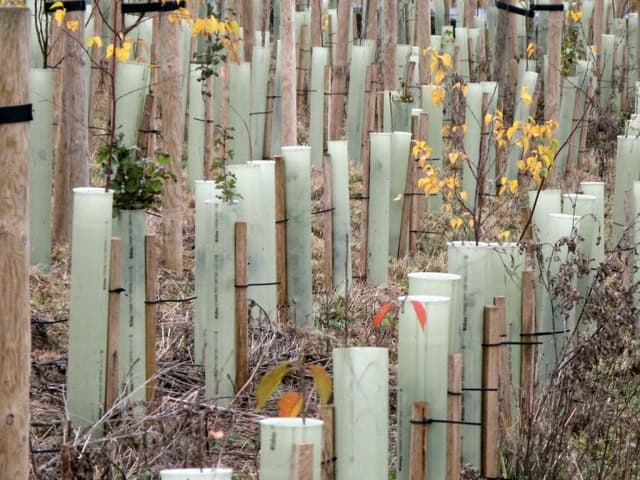
Photo: Mike Quinn / Geograph.org.uk, CC BY-SA 2.0
Tree guards go on almost automatically with new planting, whip after whip, without much thought about whether the height's actually right for what's on the land. Get it wrong and you've paid for protection that a deer can simply feed over the top of within a season or two.
The height that actually matters
Rabbits need 0.6 metres, hares 0.75. Deer are where most guards fall short: roe and muntjac need at least 1.2 metres, fallow 1.5, and red or sika 1.8. The rule that trips people up: sizing to the average animal on the land rather than the tallest one actually present. If you've got roe most of the time but the odd fallow passes through, the guard needs to be built for the fallow, not the roe, or it's only doing half the job.
Why guards fail even at the right height
Height on the spec sheet and height in the ground aren't always the same thing. A guard that leans, even slightly, gives a deer an angle to browse over the top or nose in from the side that a dead-straight guard wouldn't. Ties that aren't checked and loosened as the stem thickens end up girdling the tree rather than protecting it. And a guard that's technically tall enough but flimsy will simply get pushed over or crushed, by deer testing it, livestock rubbing against it, or just wind and frost heave over a winter.
The plastic guard problem
This is changing fast, and it's worth knowing about before you order in bulk. Around 200 million plastic tree guards have gone into the ground in the UK over the last 40 years, and most were never collected back out, left to break down into microplastics in hedgerows and woodland edges. Newer grant schemes have started reflecting that: the Trees Outside Woodland Fund, for instance, doesn't cover plastic guards or ties at all, only sustainable alternatives, and the wider direction from Defra and the Forestry Commission is heading the same way. If you're planting under any kind of grant funding, it's worth checking the current terms before you commit to plastic, since biodegradable options are now a genuinely viable alternative rather than an expensive experiment.
When guards are the right tool, and when they're not
Guards make sense for individual trees, hedgerow whips, and small numbers of standards, anywhere the cost and labour of guarding each one individually is less than the cost of fencing the whole area. Past a certain density or acreage, that flips: guarding several thousand trees individually costs more in materials and maintenance than a single, properly specified fence line, which is the territory covered in our piece on deer fencing.
Either way, the starting point is the same: knowing which species are actually using the land, and in what numbers, before you spend anything on protecting what's going into it. That's exactly what a Deer Number Survey & Impact Assessment is for.
Wondering about your own land?
Give us a call and we'll talk it through.
More from the blog