
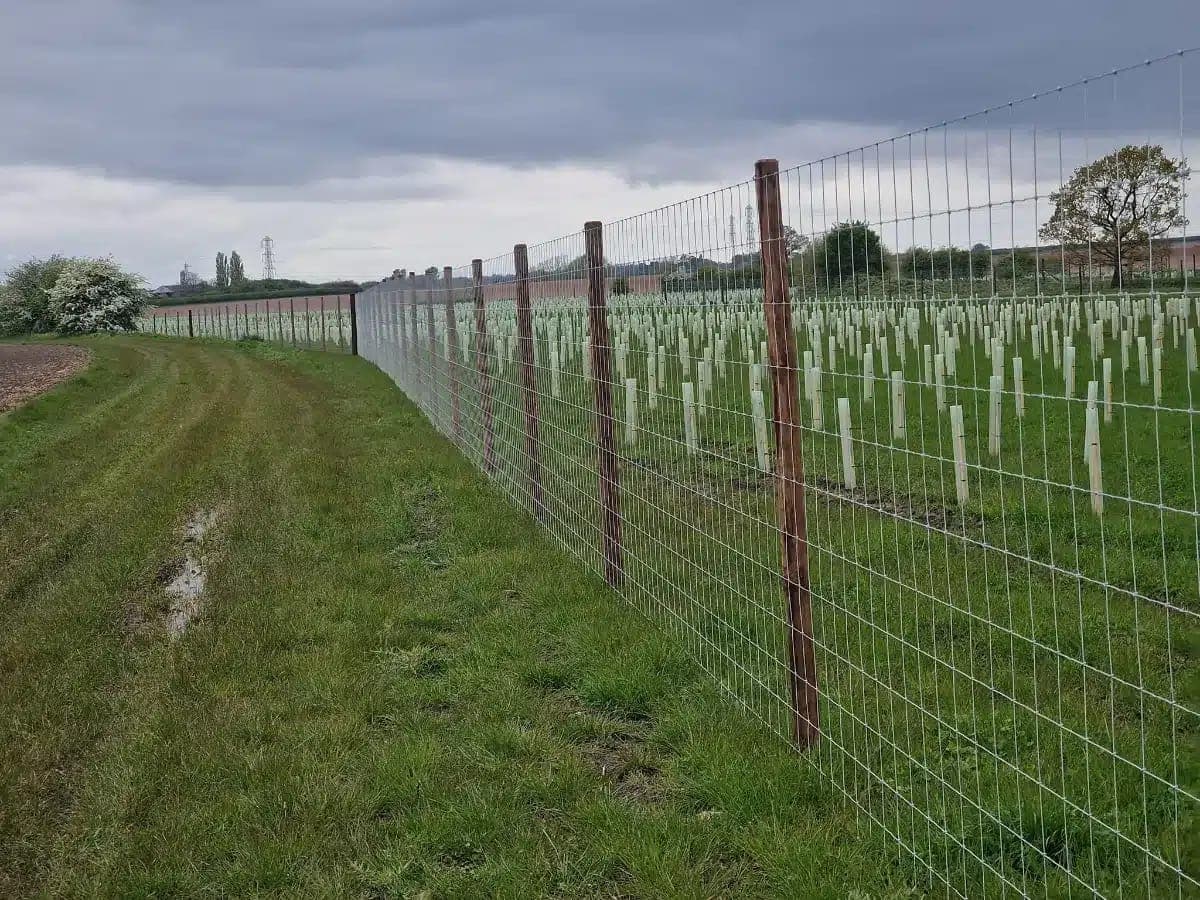
Deer Fencing: What It Actually Solves (and Where It Falls Short)
By Donaldson Deer Service · 10 August 2026
Photo: Dickson Timber, Harrogate
Deer fencing comes up a lot once damage starts showing on the land. It's easy to see the appeal. It's something you can get on with yourself, without getting other people involved. The honest answer is that it works brilliantly in some situations and is close to a waste of money in others. Knowing which is which before you spend anything makes a real difference.
How height requirements vary by species
Height is the obvious starting point. It depends entirely on what you're dealing with, and that mix varies across Yorkshire, North Lincolnshire, North Nottinghamshire, East Lancashire, and South Durham. For roe deer, the minimum is around 1.5 metres, though most people building to a proper spec go to 1.8 to be safe. Roe are decent jumpers but tend to go under or through a weak point before they'll clear a fence that height. Red and sika are a different matter. You need at least 1.8 metres, closer to 2 metres if you're fencing anything over a few acres or running alongside a road. Fence to roe height with reds on your land and you've built something they'll clear without much effort.
Why upkeep matters more than people expect
Height isn't the only thing that matters, either. Deer test a fence at ground level more than they test it at the top, so the bottom needs to sit tight to the ground or be pegged down properly. A fence that looks secure from a distance can have a gap at the base big enough for a deer to push through. They will find it. Mesh tends to hold up better than stock netting for this reason. Post spacing matters more than people expect too; wide gaps flex under pressure.
Then there's the side that doesn't get talked about enough: upkeep. A proper deer fence around anything more than a couple of acres gets expensive fast. It needs checking regularly too. Deer will find and use any weakness within a season, particularly around gates and wherever the line crosses a dip or a watercourse. Fallen branches, snow load and livestock rubbing against the wire all take their toll, so it's rarely a job you do once and forget about.
When fencing beats a cull
That's really the trade-off. Fencing a small orchard, a nursery plot, or a block of new woodland planting can be exactly the right call, especially somewhere with a lot of public access where a cull isn't practical. Fencing a whole farm, or land with awkward boundaries and multiple entry points, usually isn't. The cost and the ongoing maintenance outweigh what you're protecting. The deer are still there, still under pressure, just on the other side of the wire.
Before spending on fencing, it's worth knowing exactly what you're dealing with: how many deer, which species, where they're getting in and how much damage they're actually doing. A Deer Number Survey & Impact Assessment usually gives you that picture. It often changes the answer. Sometimes fencing is the right tool. Sometimes a properly managed cull sorts the same problem for a fraction of the cost, with nothing left to maintain once it's done.
Wondering about your own land?
Give us a call and we'll talk it through.
More from the blog